

Supplemental Technical Guidance
Steel Climate Standard — Certification, Verification, and Reporting
1 Introduction
- Providing guidance with respect to certification of steel products against the Standard;
- Providing guidance with respect to certification of Company-Average Steel Emissions Intensity (CASEI) and Science-Based Emissions Targets (SBETs) in conformance with the Standard; and
- Establishing criteria for qualifying Certification Bodies to ensure that the companies providing third-party verification of product standards and CASEI and validation of SBETs are independent and have demonstrated a specified level of technical proficiency necessary to assess the accuracy of steel product greenhouse gas (GHG) emission intensity calculations as outlined in the Standard.
This document is a supplement to the Standard, and as such shall be used by verification bodies in conjunction with the standard itself when providing certification. Section 4 of the Standard outlines the product-level accounting requirements for calculating a GHG intensity for steel product standard purposes. Section 6 of the Standard outlines the organization- level accounting requirements for calculating CASEI for target setting purposes.
The GSCC® has developed this guidance to ensure that third-party certification is implemented consistently, competently, and impartially. The GSCC®’s system for certification to the Standard will be reviewed periodically and updated as necessary to reflect best practices for assurance systems used to assess conformance with sustainability standards.
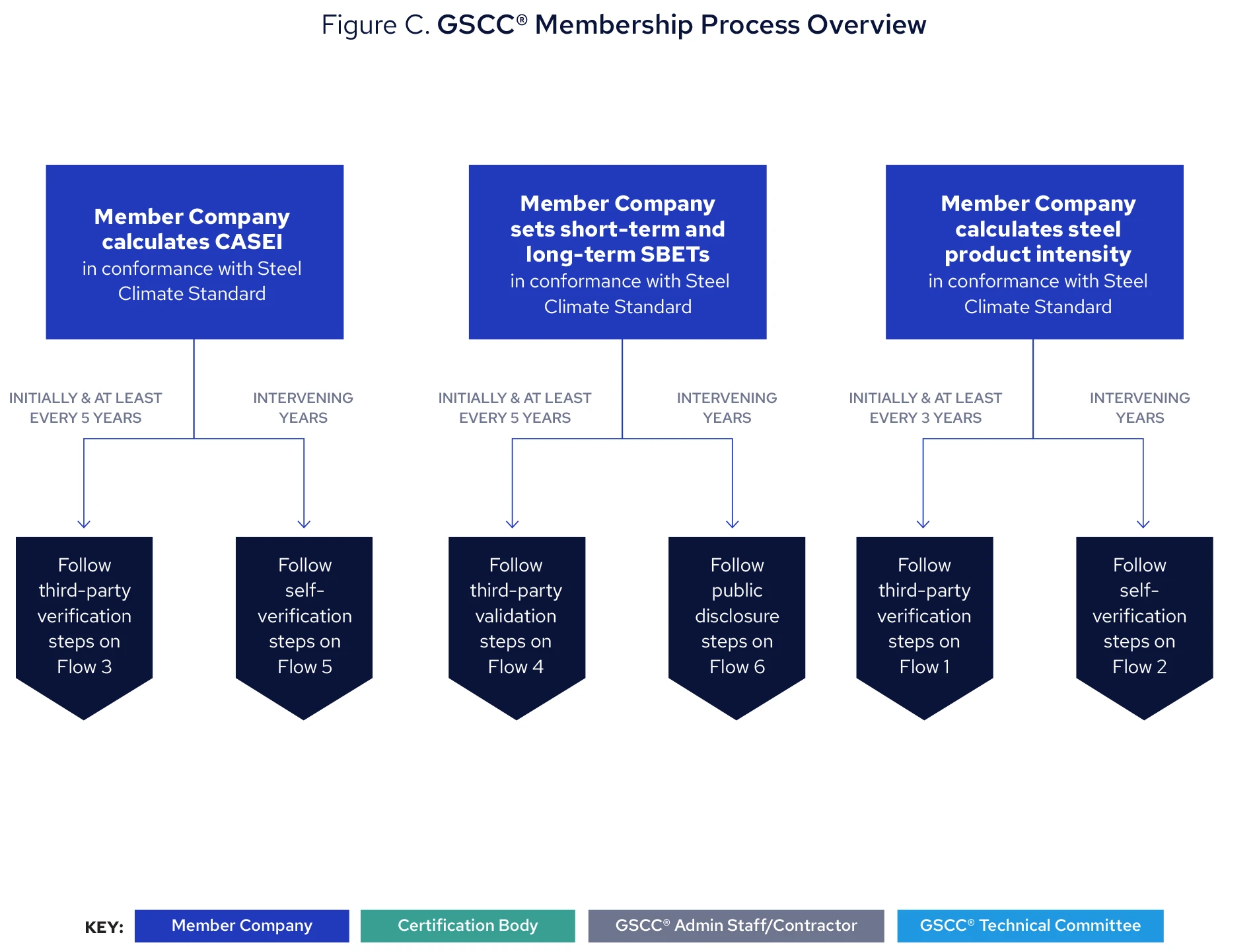
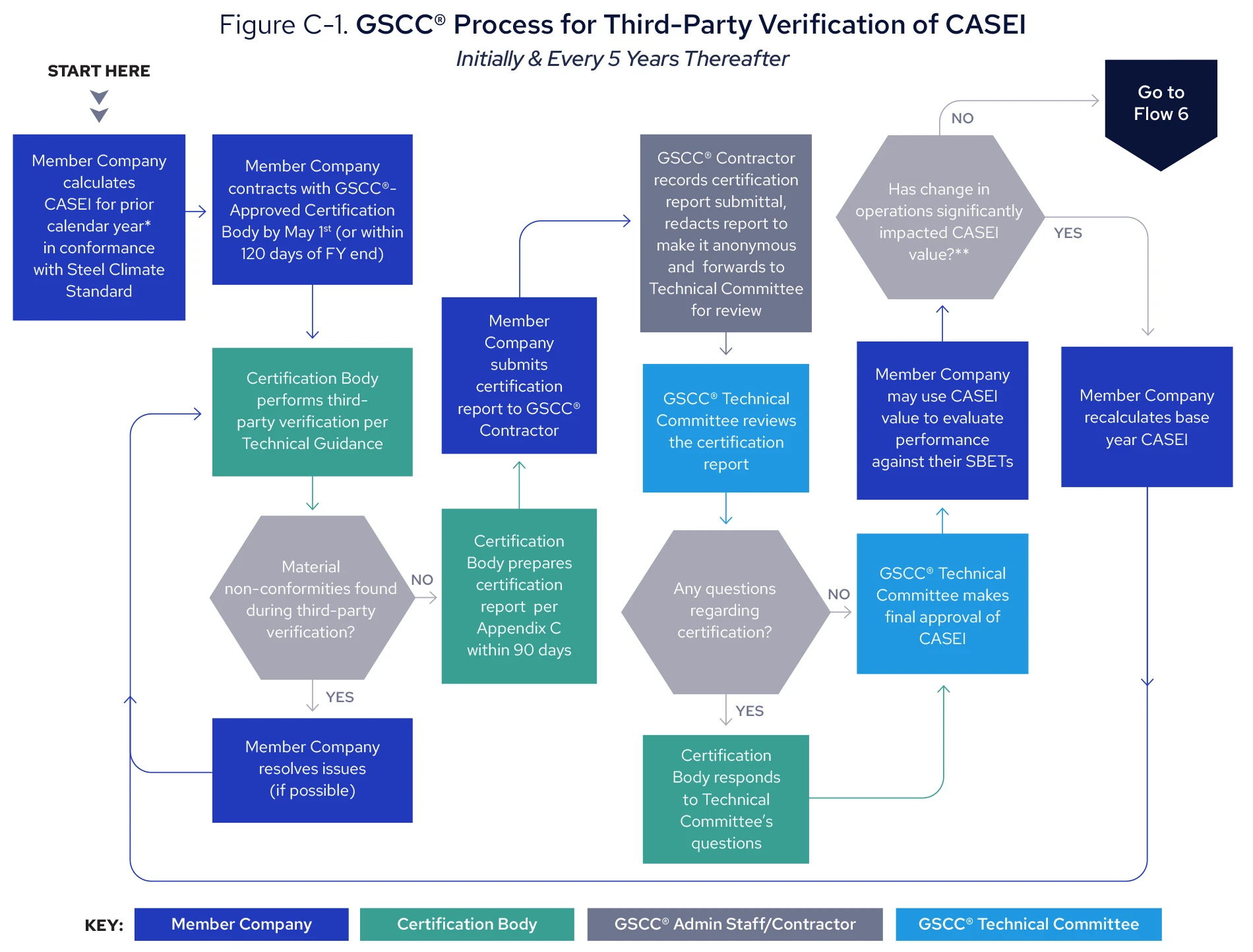
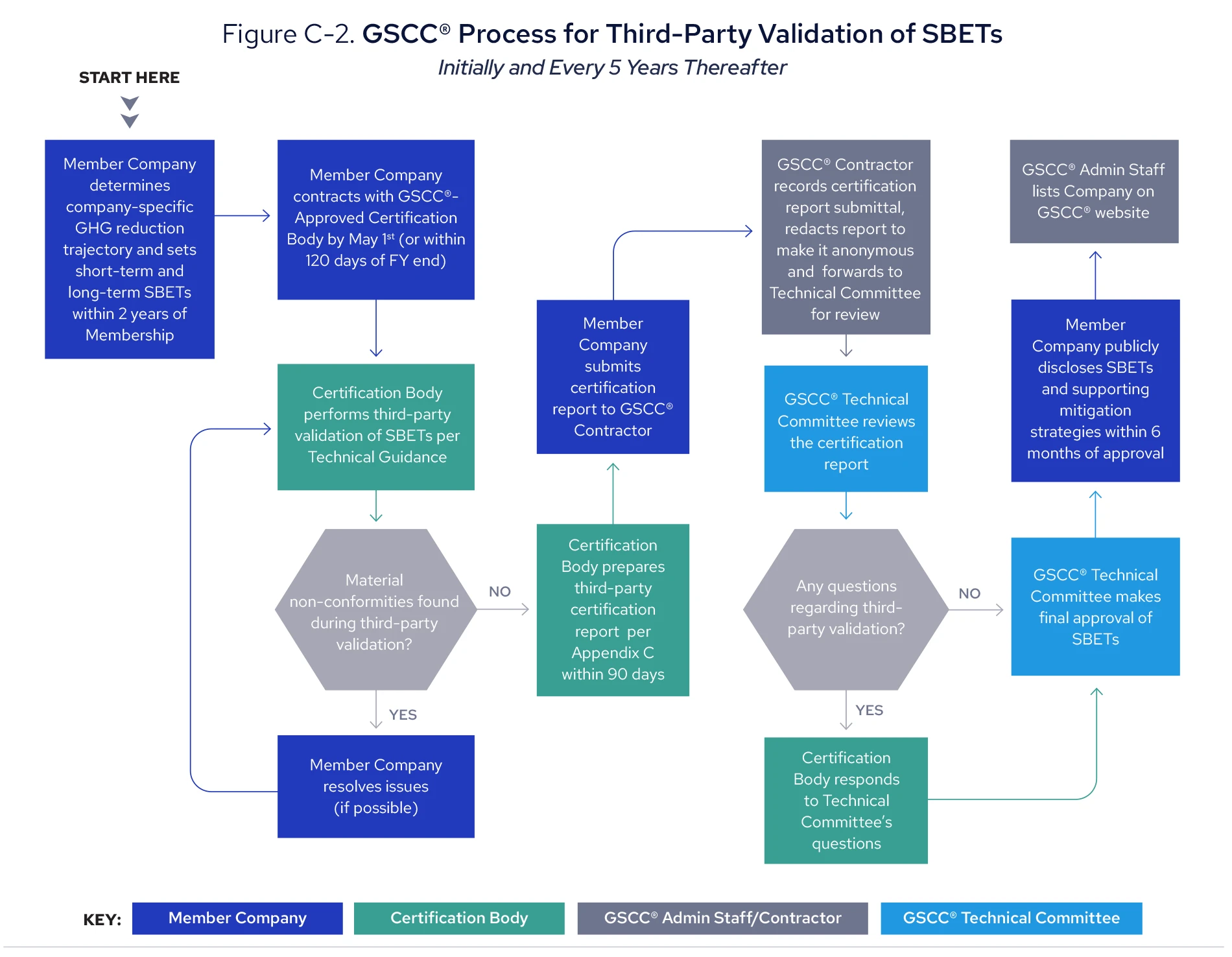
This guidance document uses the term “shall” to indicate the requirements to be met if a company is certifying its products or establishing SBETs in alignment with the Standard. The term “may” is used when describing what is allowable under this guidance, but is not necessarily required. Appendix A contains a list of the references used in this guidance document and Appendix B provides a glossary of terms. Flow charts depicting the certification processes described in this guidance document are provided in Appendix C.
1.1 Steel Climate Standard Certification Roles and Responsibilities
This section outlines the roles and responsibilities of the five key parties involved in certifying conformance with the Standard – the GSCC® Board of Directors, the GSCC® Technical Committee, GSCC® Administrative Staff / GSCC® Contractor, Certification Bodies and Member Companies. More details regarding these responsibilities are provided in the subsequent sections of this guidance document.
GSCC® Board of Directors
- Provide general oversight of the periodic review of the Standard and this guidance document, as well as any other supplemental supporting materials.
- Provide general oversight of the implementation of the Standard as outlined in this document.
- Approve members of GSCC® Technical Committee and any ad hoc committee, as necessary.
- Review and approve the rules governing the GSCC® Technical Committee, ensuring its independence and transparency.
- Review and approve/reject proposals made by GSCC® Technical Committee regarding revisions to the Standard and to this Technical Guidance Document.
GSCC® Technical Committee
- Periodically review and provide recommendations to the GSCC® Board of Directors regarding revisions to the Standard.
- Periodically review and provide recommendations to the GSCC® Board of Directors regarding revisions to this Technical Guidance Document to provide additional clarifications that may be learned through implementation of the Standard and/or to continually assess and improve GSCC®’s assurance system.
- Provide general oversight of Certification Bodies.
- Review the Certification Statements provided by Member Companies and Certification Bodies to ensure conformance with the Standard.
- Make final determination regarding approval or rejection of steel product certification and designation of company SBETs as conforming with the Standard.
- Review and mediate issues or complaints that arise through the certification process, if necessary.
- Manage appeals regarding certification decisions, if necessary.
- Review standard non-conformance issues and make final determination regarding their resolution.
- Review certification body applications and make final determination regarding approval or rejection of Certification Bodies.
- Provide initial training and on-going professional development to participating companies and Certification Bodies related to the Standard, its intent, and associated certification requirements.
- Declare a potential conflict of interest and abstain from reviewing or making recommendations related to any situation that may compromise impartiality of the GSCC® Technical Committee.
GSCC® Administrative Staff / GSCC® Contractor
- Maintain list of certified steel products (by producer and facility) on GSCC® website.
- Maintain list of companies that have established SBETs that have been designated as conforming with the Standard.
- Administer requirements for the Standard-compliant labeling of certified products.
- Administer certification body application process.
- Maintain list of approved Certification Bodies on GSCC® website.
- Manage document and record control related to the certification process.
- Redact documents that contain member company confidential business information (i.e., third-party certification reports, self-declaration reports, root cause analyses and corrective action plans) prior to GSCC® Technical Committee review to maintain anonymity.
- Maintain list of accepted verification standards on GSCC® website.
Certification Bodies
- Ensure competency of certification team as outlined in Section 4.
- Conduct certification activities in conformance with the criteria in this guidance document.
- Prepare Third-Party Certification Report (with any confidential business information redacted) containing the information outlined in Section 5.
- Respond to complaints and appeals raised during certification process as outlined in certification body’s written procedures.
- Participate in any training activities that may be required by GSCC® to ensure consistent implementation of the Standard.
- Enter into contracts with the GSCC® and the member company which includes a standard non-disclosure agreement (to be provided by GSCC®) that describes how confidential information will be managed.
- Perform internal audits of certifications of conformity to the Standard to evaluate performance on an annual basis and share the results of this internal audit with GSCC®.
Member Companies
- Contract with a certification body that is approved by GSCC®.
- Provide the certification body with the information requested in order to conduct the verification/validation.
- Facilitate interviews with appropriate company personnel as requested by the certification body during the certification process.
- Address identified non-conformities.
- Cooperate in the resolution of any complaints or appeals that arise during the certification process.
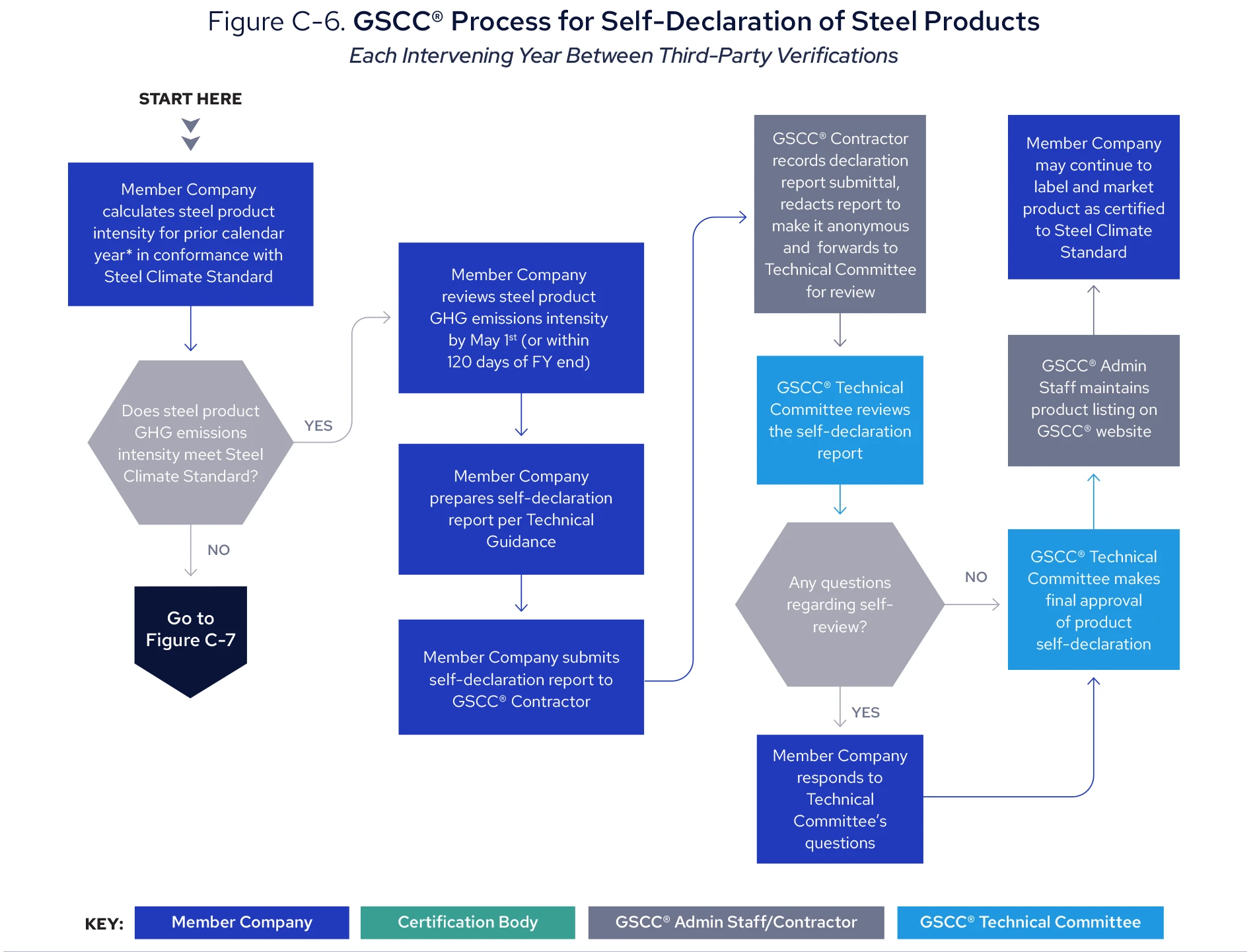
- Conduct internal review of facility-specific steel product intensity to ensure it is calculated in conformance with the Standard in years that third-party verification is not conducted and prepare a Member Company Self-Declaration Report containing the information outlined in Section 61.
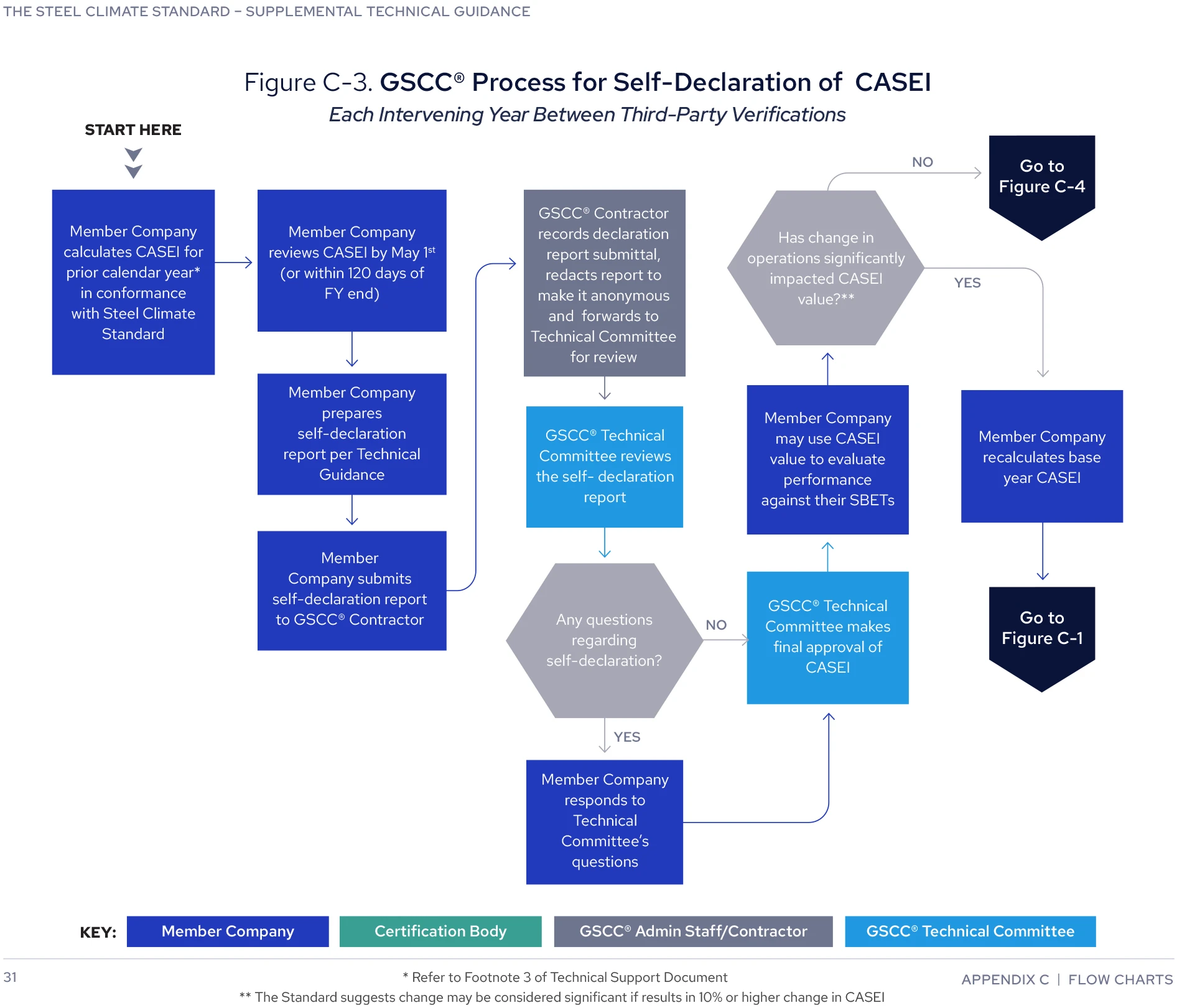
- Conduct internal review of CASEI to ensure it is calculated in conformance with the Standard in years that third-party verification is not conducted and prepare Member Company Self-Declaration Report containing, at a minimum, the information outlined in Section 62.
- Submit completed Third-Party Certification Report or Member Company Self Declaration Report to GSCC® annually to maintain certification with the Standard.
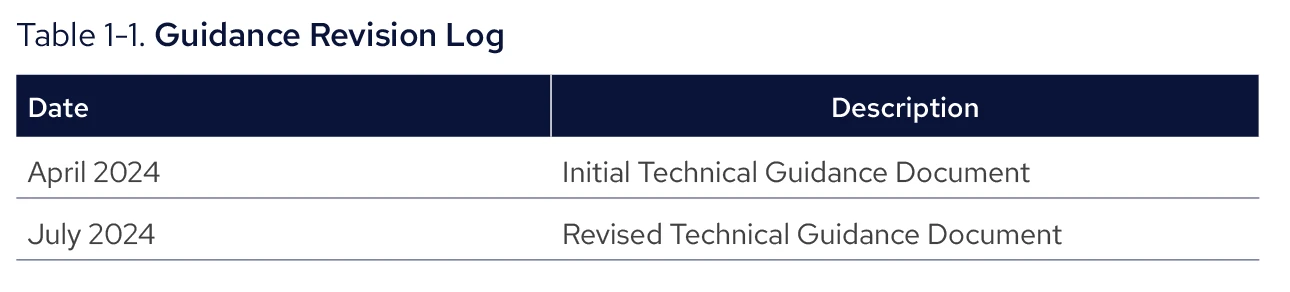
1.2 Document Revision Log
2 Certification & Labeling of Products
- The steel product’s GHG emissions intensity, in t CO₂e/t hot rolled steel, for the applicable calendar year,3 shall be less than or equal to the flat product or long product GHG intensity shown in Figure 3-1, Table D-4 (for long products) and Table D-5 (for flat products) of the Standard for that year.
- The steel product’s intensity shall be calculated as outlined in Section 4 of the Standard using a facility-specific and product-specific data set which covers all sources specified within the Standard operational boundary. The calculation shall align with the following global standards and guidance related to product life cycle GHG accounting and reporting, unless conflicting requirements are explicitly stated in the Standard or in this technical guidance document which would supersede the conflicting requirements in these standards: GHG Protocol Product Life Cycle Accounting and Reporting Standard, ISO 14040:2006, Environmental management – Life cycle assessment – Principles and framework, ISO 14044:2006, Environmental management – Life cycle assessment – Requirements and guidelines and ISO 14067:2018, Greenhouse gases — Carbon footprint of products — Requirements and guidelines for quantification for product intensity determination.
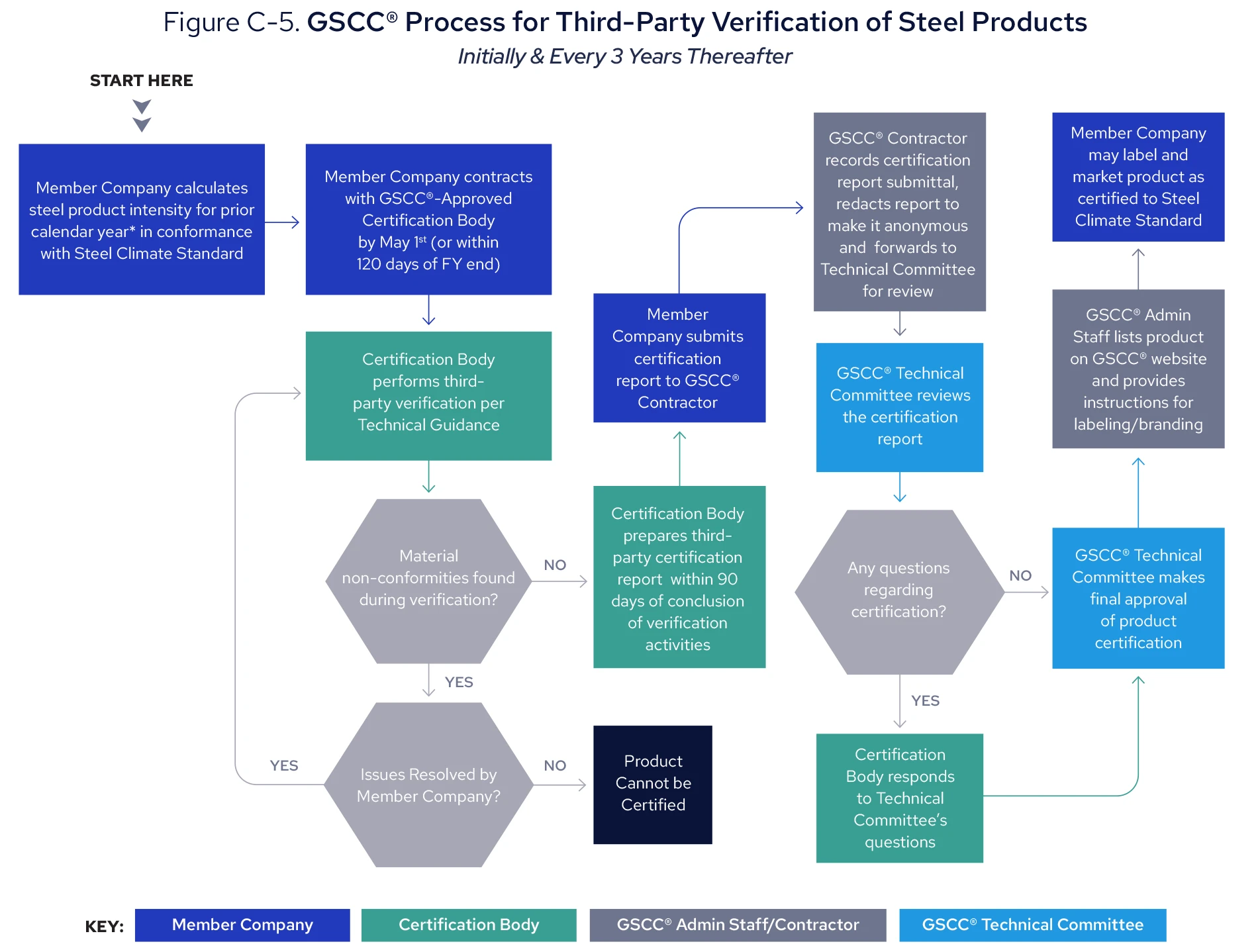
- The facility-specific steel product GHG intensity is third-party verified initially, and at least every 3 years thereafter. For the years when the member company does not seek third-party verification, the company shall self-declare that the steel product GHG intensity has been calculated and evaluated by the member company to demonstrate that the product continues to meet the Standard.
- The steel manufacturing company has established SBETs in accordance with Section 5 of the Standard.4
- Documentation of the facility-specific product GHG intensity, third-party verification (or self-declaration) and conformance with the Standard is submitted to and accepted by the GSCC® as demonstrated by publication on the GSCC® website.
Member Companies shall self-declare steel product GHG emissions intensity values for years in which third-party verification is not conducted by preparing and submitting a Member Company Self-Declaration Report to GSCC® by May 1st for the preceding calendar year3. The Member Company Self-Declaration Report shall contain, at a minimum, the information outlined in Section 6 and be signed by an officer of the company.
The requirements for third-party verification, certification and labeling of a steel product’s conformance with the Standard are outlined in the following sections. The requirements for certification of SBETs are outlined in Section 3 of this document.
2.1 Third-Party Verification of Steel Product GHG Emissions Intensity
As stated in Section 4 of the Standard, the determination of the product-level GHG emissions intensity based on the Standard boundary for hot rolled steel production shall be independently verified in conformance with the requirements of recognized international verification standards such as ISO 14064-3:2019, Greenhouse gases — Part 3: Specification with guidance for the verification and validation of greenhouse gas statements as it applies to product GHG statements.
The GSCC® will consider accepting alternative verification standards which meet the following criteria:
- Relevance: The standard shall specify that it relates to a third-party verification process and be applicable to the verification of product GHG statements.
- Competency: The GSCC® has established program-specific criteria for the competency of Certification Bodies providing third-party verification (see Section 4), therefore a statement regarding the competency of verifiers need not be explicit in the alternative verification standard.
- Independence: The GSCC® has established criteria for the independence of Certification Bodies providing third-party verification (see Section 4), therefore a statement regarding the independence and impartiality of verifiers need not be explicit in the alternative verification standard.
- Terminology: The standard shall specify the meaning of any terms used for the level of the finding (e.g. limited assurance; reasonable assurance).
- Methodology: The standard shall describe a methodology for the verification that includes the verification of the process and/or system controls and the data.
- Availability: The standard shall be publicly available for review by the GSCC® and other stakeholders.
Any other standards that meet these criteria may be submitted to the GSCC® Technical Committee for review and approval for use in verifying steel product intensities. The GSCC® will maintain a list of acceptable verification standards on its website.
Third-party verification shall be initiated by the member company by no later than May 1st for the certification of data from the preceding calendar year3. Upon completion of verification activities in conformance with a GSCC®-approved verification standard, the third-party verifier shall prepare a Third-Party Certification Report containing, at a minimum, the information outlined in Section 5 within 90 days after the conclusion of verification activities. Additional requirements regarding Certification Bodies are provided in Section 4.
2.2 Use of Environmental Product Declarations (EPDs) for Certification
Alternatively, the steel product’s GHG intensity value may be documented and verified via the third-party verification process that is used for EPDs. However, this verification would have to occur in parallel with EPD verification efforts since current product category rules (PCRs) do not align with all aspects of the Standard. For example, PCRs which reference ISO 21930:2017- 07, Sustainability in buildings and civil engineering works — Core rules for environmental product declarations of construction products and services allow the allocation of impacts (on a mass or economic basis) to steel co-products and the Standard does not. Conversely, such PCRs do not allow system expansion in order to provide emission credits for process off-gases recovered for heating and to generate electricity, whereas the Standard does allow this. Therefore, use of the EPD verification process would necessitate the calculation, reporting, and verification of an additional, separate value for steel product GHG intensity, in t CO₂e/t hot rolled steel, in order to certify the product under the Standard. This value shall be listed as a separate line item in the EPD (or in a separate third-party verified Life Cycle Assessment document) and the program operator shall verify conformance of that value to the Standard in parallel with verifying conformance of the EPD value to the selected PCR.
When using the EPD verification process to certify to the Standard, the underlying LCA shall be revised to meet the following criteria in order to determine the steel product GHG intensity value:
- Stated goal and scope definition: Shall include Steel Climate Standard product certification. The EPD that is used to certify to the Standard shall have a separate line item with the steel product intensity value that is calculated in conformance with the Standard.
- Product system to be studied: Shall be comprised of long or flat production processes at a single facility and the EPD shall provide facility- and product-specific GWP results. The Standard specifies that the steel product GHG intensity shall be facility-specific.
- Functional unit: Metric ton of flat or long hot-rolled product.
- System boundary: Shall include all processes contained in GSCC® operational boundary as indicated in Appendix B of the Standard (regardless of cut-off criteria) and end at hot rolling. While maintaining the functional unit outlined above, additional processes may be included as well, if the boundary expansion results in a higher steel product intensity value than would otherwise be calculated under the Standard (e.g., may not take credit for waste disposal).
- Allocation procedures: The life cycle GHG emissions associated with steelmaking shall not be allocated between steel products and co-products (e.g., slag). Under the definition of by-product in the Standard, allocation shall similarly not occur between steel products and by-products. However, if more than one product is manufactured at a given facility, the life cycle GHG emissions shall be allocated on a mass basis to the different products, as appropriate, in determining the product-specific GWP results.
- Impact categories: Certification to the GSCC® product standard requires an evaluation of the climate change impact category (GWP) based on the IPCC 100-year global warming potential (GWP). As indicated in Appendix B.1 of the Standard, if the 100-year GWP values available from the latest IPCC assessment report are not used, then the emissions factors or the database reference used in the calculation, as well as their source, shall be provided in the EPD.
- Data requirements: The dataset for the LCA shall be the most recent calendar year's operating data. Alternatively, if the EPD’s data set is comprised of 12 consecutive months that are not a calendar year, then the steel product intensity shall be compared to the GSCC® standard value for the calendar year when the 12-month period ends for product certification.
- Even though EPDs are valid for up to five years once verified, the underlying LCA model shall be updated annually to confirm conformance with the Standard for the given year.5
- Even though EPDs are valid for up to five years once verified, third-party verification of the product intensity to the Standard shall be conducted at least every three years.
- Data quality requirements: Shall conform with the requirements in Section 4.2 of the Standard.
- Emissions reductions due to the procurement of contractual instruments for renewable energy may be accounted for as follows:
- Determine the renewable energy share at the product level;
- Determine annual production volume for product to which contractual instruments are to be applied;
- Include an annual balance sheet in the LCA report to detail allocation of contractual instruments to annual production;
- Model allocated electricity covered by contractual instruments;
- Model allocated electricity not covered by contractual instruments using consumption grid factors; and
- Retire contractual instruments.
- Per the Standard, emissions associated with contractual instruments shall be reported separately.
- The LCA GHG calculation methodology shall conform with the requirements in Section 4 of the Standard.
- Primary data provided by the supplier of materials shall be used, if available, provided it conforms with the criteria in Section 6.4 of the Standard. The EPD shall report the calculated share of primary data used to calculate a steel product’s hot rolled steel emissions intensity in a separate line item as indicated in Section 4.2 of the Standard.
- Emissions reductions due to the procurement of contractual instruments for renewable energy may be accounted for as follows:
Upon completion of the verification activities outlined above to ensure conformance with a GSCC®-approved verification standard, the EPD program operator shall prepare a Third-Party Certification Report containing, at a minimum, the information outlined in Section 5 of this document.
2.3 Standard Non-Conformance
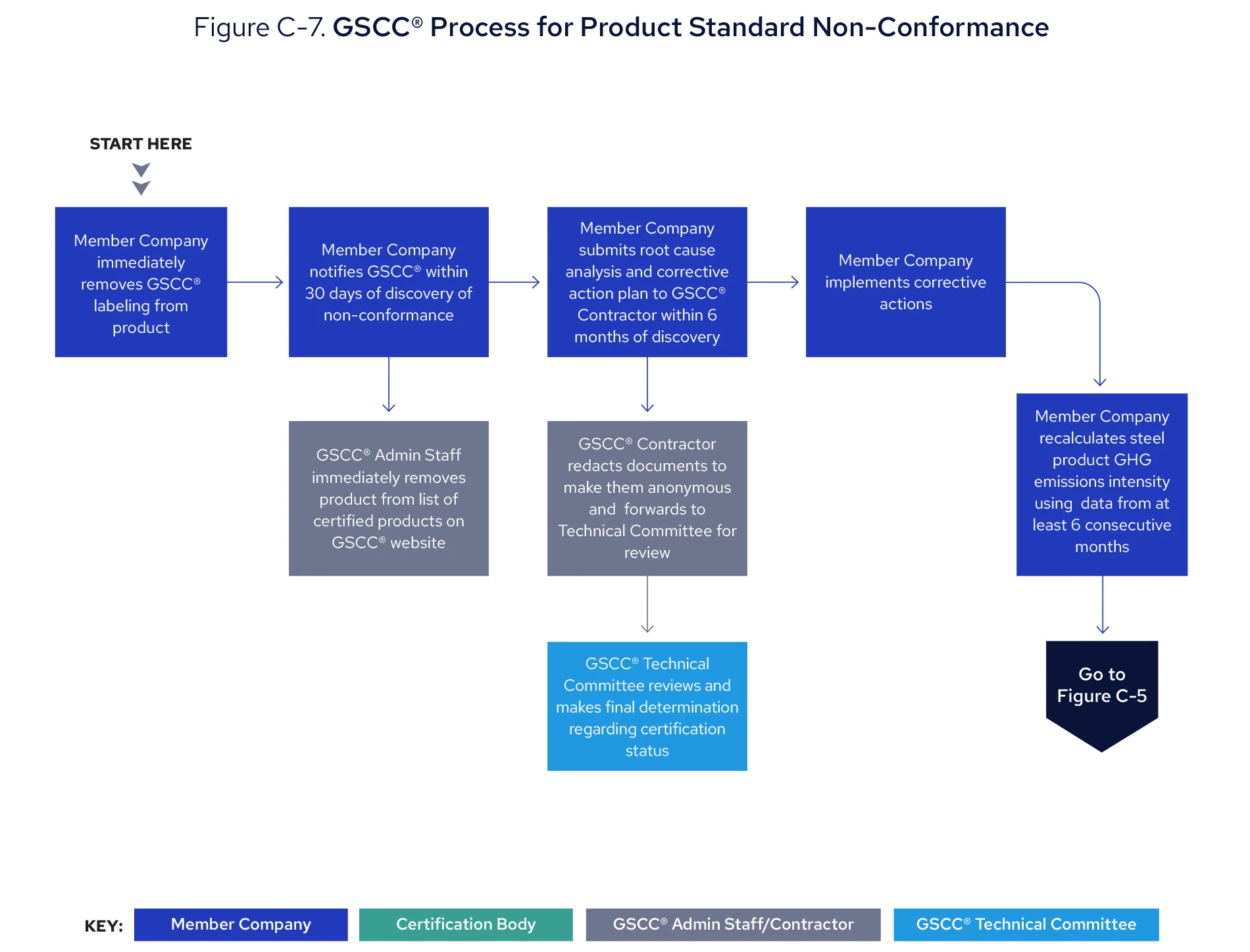
In the event that a steel product certified to the Standard fails to meet the Standard in a subsequent year, the member company shall notify the GSCC® Technical Committee within 30 days upon discovery and the product will be immediately removed from the list of certified products on the GSCC® website. The company shall immediately remove any GSCC® labeling of the impacted product as well.
The product may not be labeled as meeting the Standard until the member company submits a third-party verified steel product intensity showing conformance with the Standard that is calculated based on at least six consecutive months of operating data from the facility in question. In addition, the member company shall submit information related to the non-conformance within 6 months of discovery, identifying the root cause and documenting the corrective actions implemented to address it. Upon receipt, these reports will be redacted by a GSCC® Contractor to maintain anonymity. Then, the GSCC® Technical Committee will review documentation and make a recommendation to the GSCC® Board of Directors regarding the product’s certification status. Should this review pose a potential conflict of interest for any member of the GSCC® Technical Committee, that member shall abstain from participating in the review and/or making recommendations related to the non-conformance.
2.4 Publication and Labeling of Certified Products
Upon approval of a steel product’s certification status, the GSCC® Administrative Staff will record the steel product’s certification status and send the member company the GSCC®’s requirements for branding and labeling of the certified product. The member company shall adhere to these requirements when using the Standard’s official logo in the marketing and labeling of certified steel products. However, product labeling is voluntary. The GSCC® will provide a listing of the following information for each certified steel product on its website:
- Identification of the certified steel product;
- Company Name; and
- Address of facility where the certified product is manufactured.
3 Certification of Science-Based Emissions Targets
- Targets shall reflect an ambition of achieving the 1.5°C scenario by the year 2050 in alignment with the Steel Climate Standard Decarbonization Glidepath.
- The selected base year shall reflect a full year of representative operations and be within 5 years of the target establishment date.
- The Company-Average Steel Emissions Intensity (CASEI) for the base year shall be calculated as outlined in Section 6 of the Standard, expressed as t CO₂e/t hot rolled steel. The calculation shall align with the following global standards and guidance related to corporate-level or organization GHG accounting and reporting, unless conflicting requirements are explicitly stated in the Standard or in this technical guidance document which would supersede the conflicting requirements in these standards: GHG Protocol Corporate Accounting and Reporting Standard and ISO 14064-1:2018, Greenhouse Gases – Part 1: Specification With Guidance At The Organization Level For Quantification And Reporting Of Greenhouse Gas Emissions And Removals.
- The company-specific GHG reduction trajectory shall be developed in accordance with Step 3 procedures outlined in Section 5 of the Standard.
- The company shall establish at least one interim SBET that is at or below the company- specific GHG reduction trajectory values and is intended to be met within 5-10 years from the selected base year. Companies may elect to establish a series of interim targets.
- The company shall establish a long-term SBET that is at or below the company-specific GHG reduction trajectory values for any selected year between 2040 and 2050.
- The CASEI shall be third-party verified initially, and at least every 5 years thereafter. The CASEI shall also be third-party verified for the target year (e.g., if target is set for 2030, the CASEI shall be third-party verified in 2030 to verify attainment of the goal). For years when the member company is not required to obtain third-party verification, the member company shall perform an internal review whereby the CASEI is calculated and self-declared to GSCC® at least annually to demonstrate progress towards SBETs.
- The interim and long-term SBETs shall be third-party validated at the time they are established.
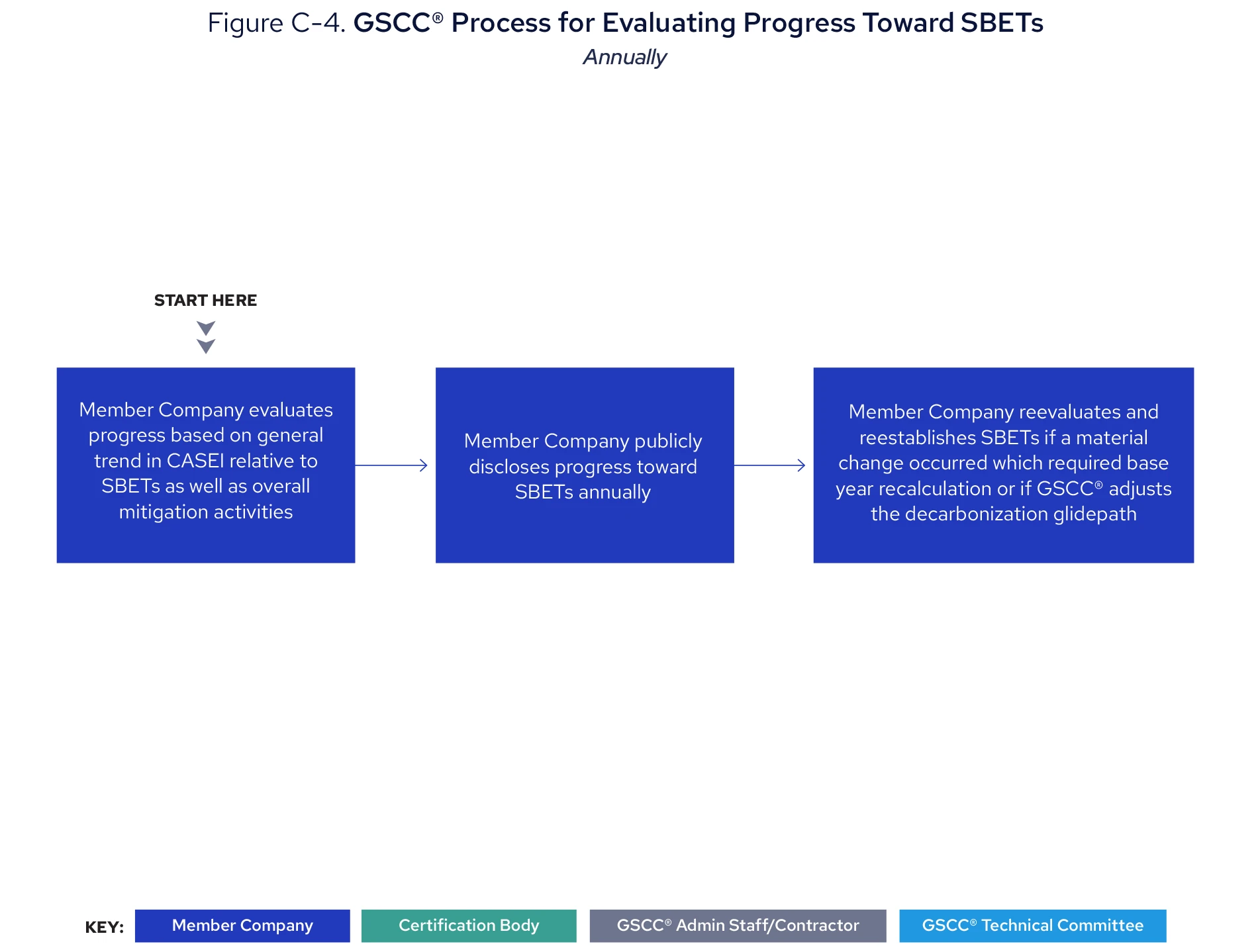
- SBETs and the company’s strategies to meet them shall be publicly disclosed as part of annual corporate sustainability reports or via reporting through a recognized carbon disclosure framework.
- The base year CASEI shall be recalculated and SBETs revised accordingly if there is a significant change that materially affects the CASEI as required by the GHG Protocol.6 According to Section 5.2 of the Standard, companies should consider a significance threshold of 10% or greater change in the calculated CASEI value.
Member Companies shall self-declare their CASEI for years in which third-party verification is not conducted by completing and submitting the Member Company Self-Declaration Report containing, at a minimum, the information outlined in Section 6 to GSCC® by May 1st of each year for the preceding calendar year.7 The Member Company Self-Declaration Report shall be signed by an officer of the company. The requirements for third-party verification/validation, self-declaration, and disclosure of a company’s conformance with the SBET requirements of the Standard are outlined in the following sections.
3.1 Third-Party Verification of CASEI
As stated in Section 6 of the Standard, determination of the CASEI for the target base year (and subsequent verification years as required) shall be independently verified in conformance with the requirements of recognized international verification standards such as ISO 14064-3:2019, Greenhouse gases — Part 3: Specification with guidance for the verification and validation of greenhouse gas statements as it applies to organization GHG statements.
The GSCC® will consider accepting alternative verification standards which meet the following criteria:
- Relevance: The standard shall specify that it relates to a third-party verification process and be applicable to the verification and validation of organizational or corporate-level GHG emissions statements.
- Competency: The GSCC® has established program-specific criteria for the competency of Certification Bodies (see Section 4), therefore a statement regarding the competency of verifiers need not be explicit in the alternative verification standard.
- Independence: The GSCC® has established criteria for the independence of Certification Bodies (see Section 4), therefore a statement regarding the independence and impartiality of verifiers need not be explicit in the alternative verification standard.
- Terminology: The standard shall specify the meaning of any terms used for the level of the finding (e.g., limited assurance; reasonable assurance).
- Methodology: The standard shall describe a methodology for the verification that includes the verification of the process and/or system controls and the data.
- Availability: The standard shall be publicly available for review by the GSCC® and other stakeholders.
Any other standards that meet these criteria may be submitted to the GSCC® Technical Committee for review and approval for use in verifying a company’s CASEI. GSCC® will maintain a list of acceptable verification standards on its website.
Third-party verification of the CASEI shall be initiated by the member company no later than May 1st for the certification of data from the preceding calendar year.7 Upon completion of verification activities in conformance with a GSCC®-approved verification standard, the third-party verifier shall prepare a Third-Party Certification Report containing, at a minimum, the information outlined in Section 5 within 90 days after the conclusion of verification activities. Additional requirements regarding Certification Bodies are provided in Section 4.
3.2 Third-Party Validation of SBETs
A company’s SBET shall be reviewed and validated in a multi-step process by an independent and competent GSCC®-approved certification body. Criteria for GSCC®-approved certification bodies are outlined in Section 4 of this guidance document. The third-party validation process shall include the following steps, at a minimum:
- Initial Screening Review for Completeness
- The member company shall provide all information and supporting documentation necessary to fully assess adherence to the fixed boundary definition, CASEI emissions calculations, and target-setting framework as prescribed by the Standard.
- The member company shall provide sufficient information regarding proposed mitigation measures to be employed to meet interim SBETs.
- The third-party certification body shall provide a notice of deficiency for any missing information, or a completeness determination if all required information has been provided.
- Verification of Base Year CASEI
- The member company shall select an appropriate base year and calculate CASEI in accordance with the Standard.
- The third-party certification body shall verify the accuracy, relevance, and completeness of the base year CASEI in accordance with the Standard.
- Validation of Interim SBETs
- The member company shall establish short-term SBETs in accordance with the Standard and outline one or more credible mitigation strategies that will be employed along with information regarding how these will be used to achieve the stated SBETs.
- The member company shall agree to commit publicly to the targets, including transparent communication of mitigation strategies.
- The certification body shall validate the interim SBETs for conformance with the Steel Climate Standard Decarbonization Glidepath and shall evaluate the reasonableness of the company’s mitigation strategies.
- Validation of Long-Term SBETs
- The member company shall establish long-term SBETs in accordance with the Standard and agree to commit publicly to the targets.
- The certification body shall validate the SBETs for conformance with the Steel Climate Standard Decarbonization Glidepath.
- GSCC® Review and Approval
- Once verification and validation are complete, the GSCC® Technical Committee shall review the results and make a determination regarding approval of the member company’s SBETs.
3.3 Publication of Targets
GSCC® Member Companies shall publicly disclose their SBETs within 6 months of approval. If the SBETs are not publicly disclosed within that timeframe, the company’s submissions related to CASEI and SBETs shall be re-evaluated. Companies may indicate that their targets have been designated as SBETs under the Standard once approved. The GSCC® will provide a list of companies that have published SBETs that align with the Standard on the GSCC® website.
4 Requirements for Certification Bodies
4.1 General Conformity
Verification of environmental information required to demonstrate conformance with the Standard shall be performed to provide a limited level of assurance or reasonable level of assurance (to be determined by the member company) that the information is accurate and reliable. Any forecasted information shall be validated to ensure that a company’s SBETs are based on a credible strategy and reasonable assumptions. In providing verification and validation, all Certification Bodies shall conform with the requirements in the following ISO standards:
- ISO/IEC 17029 (2019) Conformity assessment – General principles and requirements for validation and verification bodies
- ISO 14065 (2020) General principles and requirements for bodies validating and verifying environmental information
If a Certification Body has been accredited to these standards, they shall provide documentation of accreditation in addition to the information outlined in Section 4.3. Accreditation ensures that the Certification Body has achieved an appropriate level of organizational proficiency such that its employees (and its subcontractors) have the competence to carry out the assurance activities in accordance with the standards cited above. Hence, while accreditation to these standards is not mandatory, it is preferred.
Certification Bodies shall prepare a Third-Party Certification Report containing, at a minimum, the information outlined in Section 5. Inclusion of the identified information outlined in Section 5 ensures that the verification/validation is comprehensive and implemented consistently, competently, and impartially. Certification Bodies shall redact any information in their report which is business confidential as outlined in Section 5 prior to submittal to the GSCC®.
In the event that the certification body identifies a misstatement, non-conformity, insufficient data and/or error (i.e., an “issue”) during the sampling performed for the verification/validation process, the certification body shall request that the member company provide an explanation in order to assess the impact of the issue identified. Based on this explanation, the certification body shall determine whether additional sampling and verification/validation is required. The certification body shall document the identified issue(s) in an internal document and provide it to the member company, who shall have an opportunity within a reasonable, agreed-upon timeframe, to resolve the issue(s) prior to the certification body’s publication of a Certification Report. Certification Bodies shall use a materiality level of 5% when assessing whether an identified issue, or aggregation of issues, could result in the steel product GHG emission intensity value or CASEI not meeting GSCC®’s certification criteria.
4.2 Competency and Independence of Certification Bodies
4.2.1 Competence
An approved GSCC® certification body shall conform with ISO 14066 (2023) Environmental information - Competence requirements for teams verifying and validating environmental information. This includes the team collectively having sufficient technical expertise in the following areas:
- Evaluation of an organization’s or product’s specific GHG activity and technology;
- Identification of GHG sources, sinks and reservoirs;
- Quantification, monitoring and reporting of GHG emissions or removals, with an understanding of relevant technical and steel sector-specific issues;
- Understanding of situations that can affect the materiality of GHG statements, including typical and atypical operating conditions;
- Evaluation of GHG information systems to determine the effectiveness of data collection, analysis and reporting as it relates to developing credible GHG emissions quantification;
- Assessment of product life cycle GHG emissions; and
- In-depth knowledge of the Standard, its intent, and the associated certification requirements.
4.2.2 Independence
An approved GSCC® certification body shall maintain its independence by conforming to the requirements for management of impartiality in ISO 17029 (Section 5.3) when performing verification and validation to the Standard. This includes the following:
- Certification bodies shall perform verification and validation activities impartially.
- Certification bodies shall monitor their activities, their relationships, and the relationships of their personnel, to identify any potential conflicts of interest.
- Certification bodies shall assess whether any potential conflicts of interest exist between themselves and the member companies who contract them, such as:
- The certification body and the member company share any staff at the managerial or Board of Directors level.
- Any management staff of the member company has been employed by the certification body, or vice versa, within the last five years.
- Any employee of the certification body or member of the certification team (including subcontractors) have provided support related to GHG emissions quantification, related activity data management and/or emission factor development within the last five years.
- If a potential conflict of interest is identified, its effect shall be eliminated or minimized so that impartiality is not compromised. In addition, any potential conflicts of interest shall be reported by the certification body to the GSCC® Technical Committee for review.
- Certification bodies shall have top management’s commitment to the importance of impartiality in executing verification and validation activities that is publicly available.
- Personnel who review the verification and validation results and issue a decision with respect conformance with the Standard shall be different from the personnel who execute the verification and validation.
- Certification bodies shall not provide both consultancy services and verification/validation services related to conformance with the Standard for the same client in the same review period. Specifically, a certification body shall not verify or validate any work related to the collection of activity and emissions data, calculation of steel product GHG emission intensity or CASEI, determination of SBETs, or any intellectual property provided either directly or indirectly by anyone employed or having a relationship with the same certification body providing verification and/or validation during the same review period.
4.2.3 Complaints and Appeals Procedures
The certification body shall have a written procedure in place by which a member company may file an appeal regarding a certification decision or a complaint about the GSCC® certification process. The certification body shall report any such appeals or complaints, and the outcomes of their resolution, to the GSCC® Technical Committee. The GSCC® Technical Committee shall get involved, as necessary, to mediate complaints and appeals by creating an impartial ad hoc subcommittee to review the situation. In addition, the GSCC® Technical Committee shall review this information to determine whether training, calibration, or other activities are required to ensure that the Standard is implemented consistently. The GSCC® also reserves the right to assess the nature of repeated complaints to determine whether a certification body’s approval should be revoked.
4.3 GSCC® Certification Body Approval Process
In order to be approved by GSCC®, Certification Bodies shall be legally incorporated entities and shall provide the following information through the submission of a form, which will be made available on the GSCC® website. The information to be provided may include, but may not be limited to, the following:
- Certification body legal name;
- Certification body address (include addresses for all offices seeking approval);
- Name of certification body’s point of contact for Standard conformance verification/ validation services;
- Description of the certification body’s general services performed for steel industry sector clients;
- Description of the certification body’s experience (project examples) with the following:
- Setting and/or validating GHG reduction targets;
- Quantifying and/or verifying GHG emissions at the organization level;
- Quantifying and/or verifying GHG emissions at the product-level;
- Documentation of accreditation to ISO/IEC 17029 (2019) and ISO 14065 (2020), if applicable;
- Resumes or CVs for the certification body’s lead verifiers/validators;
- Description of the certification body’s internal quality control/quality assurance procedures, audit protocols, and procedures for identifying, correcting, and disclosing exceptions or non-conformities;
- Description of the certification body’s commitment to impartiality and procedures implemented to ensure that no conflict of interest exists as defined in this guidance; and
- Description of procedures in place for handling any appeals and/or complaints lodged relating to the verification and validation process and/or decisions rendered by the certification body.
The certification body’s application shall be reviewed by the GSCC® Technical Committee. The GSCC® Technical Committee may engage with the applicant to obtain further clarification, as needed. Once the application is reviewed, the Technical Committee shall make the final determination whether to approve or reject the certification body’s application.
Upon approval by GSCC®, a certification body will be added to the list of approved verification/validation providers on the GSCC® website. GSCC® will periodically review this list to ensure that it is current and may request updated information for the purpose of re-evaluating a certification body’s approval status.
5 Third-Party Certification Report Requirements
General information:
- Member Company Name
- Facility Type (e.g., integrated mill, mini mill, micro mill)
- Facility Location (state, province, country)
- Certification Body Name
- Period of time for which emissions data is verified
- Verification standard used
- Level of assurance - limited or reasonable assurance, shall be stated
- Verification opinion – formal written declaration that provides confidence that the GHG Emissions statement (steel product GHG emission intensity, CASEI) is materially correct and conforms with the Steel Climate Standard (the Standard) criteria for product certification
- Validation opinion – formal written declaration that provides confidence that the established SBETs and underlying strategies to achieve interim targets are based on reasonable assumptions and materially conform with the Standard criteria for target setting
- Name and signature of lead verifier
Information to be provided re: steel product GHG emission intensity verification:
- The facility-specific steel product’s GHG emissions intensity, in t CO₂e/t hot rolled steel, is calculated in conformance with Section 4 of the Standard.
- The facility-specific steel product’s GHG emissions intensity calculation includes all processes identified as within the Standard boundaries as defined in Appendix B of the Standard.
- The facility-specific steel product’s GHG emissions intensity is at or below the Standard for long or flat products, as applicable, for the calendar year in question.
- In addition, the following information shall be provided:
- Indication of whether contractual instruments for renewable energy are factored into the GHG emissions intensity value.
- Indication of whether Renewable Thermal Certificates are factored into the GHG emissions intensity value.
- Indication of whether emissions reduction form the use of process off-gases recovered for reheating and to generate electricity are factored into the GHG emissions intensity value.
- Indication of whether biogenic carbon is factored into the GHG emissions intensity value.
Information to be provided re: CASEI verification
- The member company’s CASEI, in t CO₂e/t hot rolled steel, is calculated in conformance with Section 6 of the Standard and includes all processes identified as within the Standard boundaries as defined in Appendix B of the Standard.
- The base year CASEI represents a full year of representative operations and is not earlier than five years before the year during which the member company is establishing the SBET.
- Explanation/justification for recalculation of the base year CASEI if there is a material change that results in a 10% or greater change in the calculated CASEI value.
- Explanation for any year-over-year increase in CASEI, along with identification of the specific measures to be taken and conditions to be in place to ensure that SBETs will still be met. Documentation shall be sufficient to demonstrate that mitigation strategies are being effectively implemented in the appropriate timeline to show further progress toward interim and long-term SBETs.
Information to be provided re: SBET validation
- The SBETs are established and publicly disclosed within two years of the member company joining the GSCC®.
- The member company’s established targets are set at or below the required company- specific trajectory determined in conformance with Step 3 of the Standard’s target-setting framework.
- The company has established interim and long-term SBETs in conformance with the Standard’s target-setting framework.
- The member company’s strategy for achievement of established SBETs and its progress toward meeting the SBETs are disclosed publicly and reasonably support the attainment of established interim targets.
Certification Bodies shall redact any information that the member company deems to be Confidential Business Information (CBI) prior to submittal to the GSCC® for review.
6 Member Company Self-Declaration Report Requirements
General information:
- Member Company Name
- Facility Type (e.g., integrated mill, mini mill, micro mill)
- Facility Location (state, province, country)
- Period of time for which emissions data is verified
- Declaration Statement – formal written declaration that provides confidence that the environmental information statement is materially correct and conforms with the Steel Climate Standard (the Standard) criteria
- Name and signature of company officer providing certification
Information to be provided re: steel product GHG emissions intensity self-declaration:
- The facility-specific steel product’s GHG emissions intensity, in t CO₂e/t hot rolled steel, is calculated in conformance with Section 4 of the Standard and includes all processes identified as within the Standard boundaries as defined in Appendix B of the Standard.
- The facility-specific steel product’s GHG emissions intensity is at or below the Standard for long or flat products, as applicable, for the time period in question.
- In addition, the following information shall be provided in the report:
- Indication of whether contractual instruments for renewable energy are factored into the GHG emissions intensity value.
- Indication of whether Renewable Thermal Certificates are factored into the GHG emissions intensity value.
- Indication of whether emissions reduction from the use of process off-gases recovered for reheating and to generate electricity are factored into the GHG emissions intensity value.
- Indication of whether biogenic carbon is factored into the GHG emissions intensity value.
Information to be provided re: CASEI self-declaration:
- The member company’s CASEI, in t CO₂e/t hot rolled steel, is calculated in conformance with Section 6 of the Standard and includes all processes identified as within the Standard boundaries as defined in Appendix B of the Standard.
- Explanation for any year-over-year increase in CASEI, along with identification of the specific measures to be taken and conditions to be in place to ensure that SBETs will still be met. Documentation shall be sufficient to demonstrate that mitigation strategies are being effectively implemented in the appropriate timeline to show further progress toward interim and long-term SBETs.
Member Companies may redact any information that they deem to be Confidential Business Information (CBI) prior to submittal to the GSCC® for review.
Appendix A. References
2022 ACLCA PCR Open Standard v1.0, Guidance for Quantifying Renewable Electricity Instruments in EPDs, May 26, 2023. Available at: https://aclca.org/wp-content/uploads/2022-ACLCA-PCR-Open-Standard_Addendum_Quantifying-Renewable-Electricity-Instruments-in-EPDs_FINAL_061323.pdf
ISEAL Code of Good Practice – Assuring Compliance with Social and Environmental Standards, Version 2.0, January 2018. Available at: https://www.isealalliance.org/sites/default/files/resource/2018-02/ISEAL_Assurance_Code_Version_2.0.pdf
ISO 14025:2006, Environmental labels and declarations — Type III environmental declarations — Principles and procedures
ISO 14064-3:2019, Greenhouse gases — Part 3: Specification with guidance for the verification and validation of greenhouse gas statements
ISO 14065 (2020) General principles and requirements for bodies validating and verifying environmental information
ISO 14066 (2023) Environmental information - Competence requirements for teams verifying and validating environmental information
ISO/IEC 17029 (2019) Conformity assessment – General principles and requirements for validation and verification bodies
Appendix B. Definition of Terms
- Appeal
- Request by the company objecting to a non-conformity determination by a certifying body.
- Certification Body
- An independent and impartial organization that provides written assurance that a product, service, or system meets specific requirements.
- Competence
- Ability to apply knowledge and skills to achieve intended results.
- Corrective Action
- Action to eliminate the cause of a non-conformity and prevent its reoccurrence.
- Lead Verifier/Validator
- Person from certification body who manages the verification or validation team.
- Materiality Level
- The quantitative threshold or cut-off point above which misstatements, individually or when aggregated with other misstatements, are considered material by the verifier.
- Non-Conformity
- A deviation from the requirements or specifications of the Steel Climate Standard, including any standards incorporated by reference (e.g., ISO). Non-conformities can be categorized as major, minor, or improvement opportunities. Major non-conformities are those which result in a fundamental or systemic failure to meet the Steel Climate Standard qualifying criteria or prescribed methodologies. Minor non-conformities are isolated deviations with limited impacts that do not prevent the company from meeting the standard. Improvement opportunities are items which do not prevent the company from meeting the standard, but may pose a risk of future non-conformance.
- Validation
- The process of evaluating the reasonableness of the assumptions, limitations, and methods that support a statement or claim about the outcome of future activities.
- Verification
- The process for evaluating a statement of historical data and information to determine if the statement is materially correct and conforms to specific criteria used as a reference against which the statement is compared.
Appendix C. Flow Charts
Appendix D. Footnotes
1 The Steel Climate Standard requires third-party verification of steel product GHG emissions intensity values at least every three years. However, member companies may choose to seek third-party verification on a more frequent basis. Self-declaration by member companies is required for the years that verification is not conducted.
2 The Steel Climate Standard requires third-party verification of CASEI values at least every five years. However, member companies may choose to seek third-party verification on a more frequent basis. Self-declaration by member companies is required for the years that verification is not conducted.
3 A company may choose to calculate steel product GHG emissions intensity on a fiscal year basis, as long as the calculations are based on 12 consecutive months of operating data. In this case, the member company shall self-verify the steel product GHG emissions intensity values, or shall engage a certification body to provide third-party verification of the steel product GHG emissions intensity values, within 120 days of the fiscal year-end rather than by May 1st (which is the due date if calculating on a calendar year basis).
4 SBETs shall be established by successful completion of the tasks outlined in Flow 4 of the charts provided in Appendix C of this document.
5 In this instance, the review in support of a self-delclaration may be performed on behalf of the member company by a contracted LCA practitioner.
6 Chapter 5 (p. 35) of the GHG Protocol Corporate Accounting and Reporting Standard requires the development of a base year emission recalculation policy which states any “significance threshold” applied for deciding on historic emissions calculation.
7 A company may choose to calculate its CASEI on a fiscal year basis, as long as the calculations are based on 12 consecutive months of operating data. In this case, the member company shall self-verify its CASEI, or shall engage a certification body to provide third-party verification of the CASEI, within 120 days of the fiscal year-end rather than by May 1st (which is the due date if calculating on a calendar year basis).
- Introduction
- Certification & Labeling of Products
- Certification of Science-Based Emissions Targets
- Requirements for Certification Bodies
- Third-Party Certification Report Requirements
- Member Company Self-Declaration Report Requirements
- Appendix A. References
- Appendix B. Definition of Terms
- Appendix C. Flow Charts
- Appendix D. Footnotes